Think about the last time you hesitated before bending down to tie your shoe, or felt that familiar twinge when lifting shopping bags from the car boot. That moment of uncertainty wondering if your back will “go” is exactly what spine health is about.
It’s not about having a perfect spine or never feeling any discomfort. It’s about your back letting you do what matters to you without constantly second-guessing every movement. Whether that’s getting through a full day at work, picking up grandchildren, or just getting a decent night’s sleep without waking up stiff and sore.
Your spine is cleverer than you think
Your spine works a bit like a modern suspension bridge, it’s not meant to be rigid, but clever. Those 33 vertebrae stacked up your back act like individual building blocks, separated by soft discs that work as shock absorbers. Muscles and ligaments hold everything together while still allowing movement. When one part of this system gets irritated or fatigued, the whole structure feels it.
Here’s what most people don’t realise: your spine is designed to move and carry load. It’s not a delicate stack of china plates that’ll shatter if you bend the wrong way. The problems start when muscles get weak or tired, when joints get stiff from lack of movement, or when your nervous system gets stuck on high alert after an injury.
When everything coordinates well – muscles firing at the right time, joints moving freely, nerves not overreacting to normal sensations – your spine shares forces efficiently. Tissues stay below their “irritation threshold,” which is just a fancy way of saying nothing gets aggravated enough to hurt.
The brain-back connection nobody talks about
Here’s something that surprises people: spine health isn’t just about your back. It’s also about your brain, your sleep, your stress levels and your beliefs about what’s happening in your body.
Long-term back or neck pain links closely with stress, poor sleep, low mood and worry about movement. We see this constantly at the clinic – someone’s back improves dramatically once they’re sleeping better, even though the actual structure of their spine hasn’t changed. Or their pain settles when they understand what’s actually going on, rather than lying awake at night imagining the worst.
This is why modern guidelines emphasise education, exercise and psychological support alongside any physical treatment. It’s not that the pain is “all in your head” that’s dismissive and untrue. It’s that pain is a complex experience that involves both body and brain, and you need to address both to get lasting improvement.
Many people in our local Hexham community tell us they felt immediately better just from understanding what was happening, rather than being handed a scan report full of scary words with no explanation.
Why your scan might look worse than you feel (or vice versa)
Right, let’s address the elephant in the room: MRI scans.
Here’s something that surprises almost everyone who sits in our clinic: if we scanned the spines of 100 pain-free people over 40, we’d find disc bulges, degeneration and small tears in the majority of them. These people are walking around Hexham, doing their shopping, playing with grandchildren, completely unaware their scans would look “abnormal.”
This isn’t me trying to make you feel better. This is what international research reviews consistently show. Most people over 40 have “changes” on spinal MRI even when they have zero pain.
This is why we spend time really talking through scan reports. That word “degeneration” on your MRI? It’s frightening. It sounds like your spine is crumbling. But it’s closer to getting grey hair – a completely normal part of living in a body that’s been working hard for decades.
Modern guidelines from the World Health Organization and specialist spine groups all agree on this: function, symptoms and goals matter more than the scan image alone. We care about what you can do, how your pain behaves day-to-day, and how your spine tolerates normal loading – not just what your MRI shows.
At InSync, we often combine your clinical assessment with objective strength and balance testing using our Vald ForceDecks system. This means you leave with clear numbers and targets instead of vague reassurance (“it’ll be fine”) or fear-based language (“your spine is degenerating”). You can see how your body is actually performing, not just how it looks on a static scan.
How long does back pain actually take to heal?
Nobody wants to hear “it’ll take twelve weeks” when they’re in pain today. But knowing realistic timelines helps in two ways: it stops you panicking when you’re not miraculously better after a week, and it tells you when to ask for more help if things aren’t tracking as they should.
These timeframes aren’t guarantees, your body isn’t reading a textbook, but they give you a framework to work with:
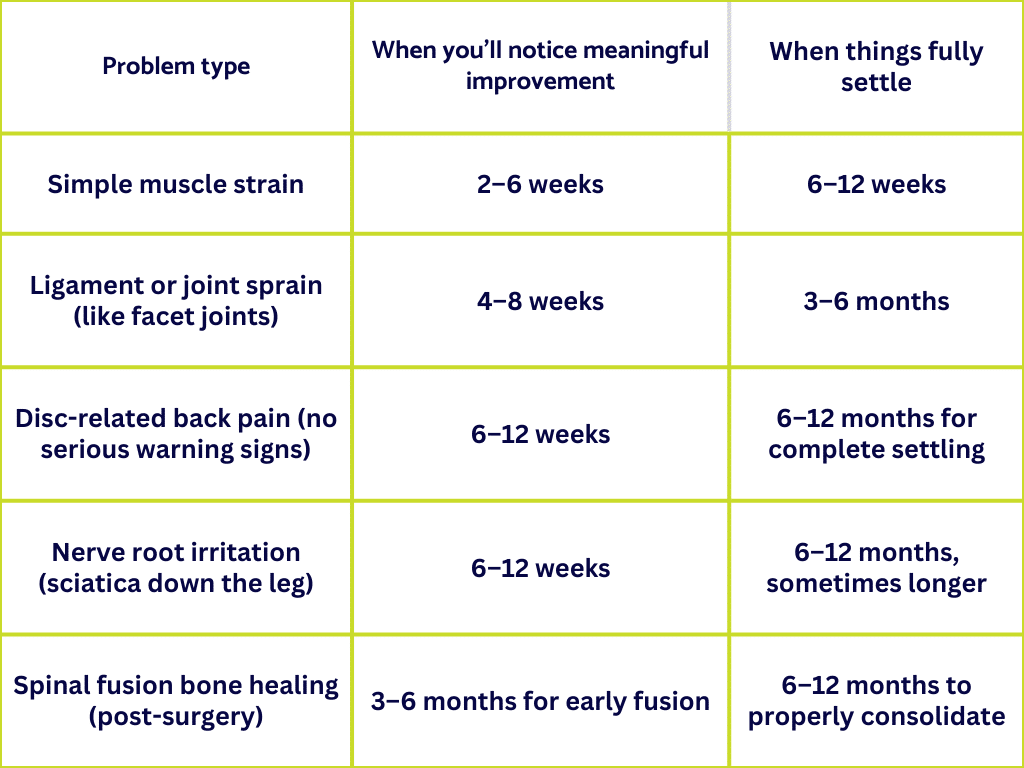
Notice how most things improve meaningfully well before they’re completely “healed”? That’s normal. You might still have the odd niggle when you’ve overdone it at eight weeks, even though you’re back doing most things. The mistake people make is expecting zero symptoms before they start living again.
Most acute low back pain improves significantly within 4–6 weeks with simple advice, staying active and appropriate pain relief. The WHO’s 2023 guideline for chronic low back pain emphasises that even long-standing pain can improve with a structured combination of exercise, education and psychological support.
Why pain can hang around longer than the actual damage
Here’s something that confuses people: pain timelines don’t always match tissue healing timelines.
Let’s say you strain your back lifting something heavy. The actual muscle or ligament damage might heal in six to eight weeks. But if you’ve spent those eight weeks barely moving, convinced your back is fragile, sleeping poorly because you’re worried, the pain can persist long after the tissues have physically repaired.
Once pain hangs around for longer than about three months, your nervous system can become more sensitive. This means normal movements or loads feel more painful than they should. It’s like the volume knob on your pain system has been turned up.
This doesn’t mean ongoing damage. It doesn’t mean you’re making it up. It means your nervous system is on high alert, trying to protect you, but doing so a bit too enthusiastically.
Sleep quality, stress levels, beliefs about your back and general fitness all influence this sensitivity. This is one reason why guidelines recommend approaches like graded exercise, cognitive behavioural strategies and reassurance that your spine is usually robust, not fragile.
We routinely see people at InSync whose scan findings haven’t changed at all, but whose pain and function improve dramatically once we balance load, build strength and address fears around movement. Using ForceDecks, we track improvements in strength, balance and control so you can see your progress even before all pain disappears. When you see your numbers improving week after week, it’s harder for your brain to maintain the story that your back is getting worse.
When should you actually seek help?
Many short-lived back or neck pain episodes settle with simple self-care – gentle movement, heat or ice, over-the-counter painkillers and a bit of patience. But there are clear times when you should seek professional help quickly.
Red flag symptoms – get urgent medical help
Right, let’s talk about the scary stuff because not talking about it makes people more anxious, not less. These “red flag” symptoms are genuinely important, but they’re also genuinely rare. We mention them not to frighten you, but so you know what actually needs urgent attention versus what can wait for a normal GP or physio appointment.
You should speak to your GP, call NHS 111 or attend urgent care if you notice:
These signs can indicate serious issues like cauda equina syndrome (severe nerve compression), infection, fracture or tumour. They need urgent medical attention, but again – they’re uncommon. Most back pain, even severe back pain, doesn’t involve any of these.
When to see a physiotherapist or spine specialist
You don’t need to wait for severe symptoms or tick all the boxes before asking for help. Current evidence-based guidelines suggest seeking assessment if:
Recent guideline drafts for acute low back pain emphasise early education and active strategies in primary and community settings to prevent chronic problems. Local physiotherapy is well-placed to deliver this kind of care in a practical, cost-effective way.
At InSync, we often see people at that 2–6 week mark when things aren’t settling as expected, or earlier if their pain is significantly limiting work or family life. A focused assessment helps you understand what’s going on, what to do now, what to avoid, and gives you a clear plan rather than a vague “wait and see” approach.
Decoding spine medical terminology
Let’s decode some of the medical jargon you’ll see on scan reports and clinic letters. These terms sound terrifying when you first read them, partly because “disease” and “degeneration” are genuinely frightening words, and partly because nobody’s explained what they actually mean in your specific situation.
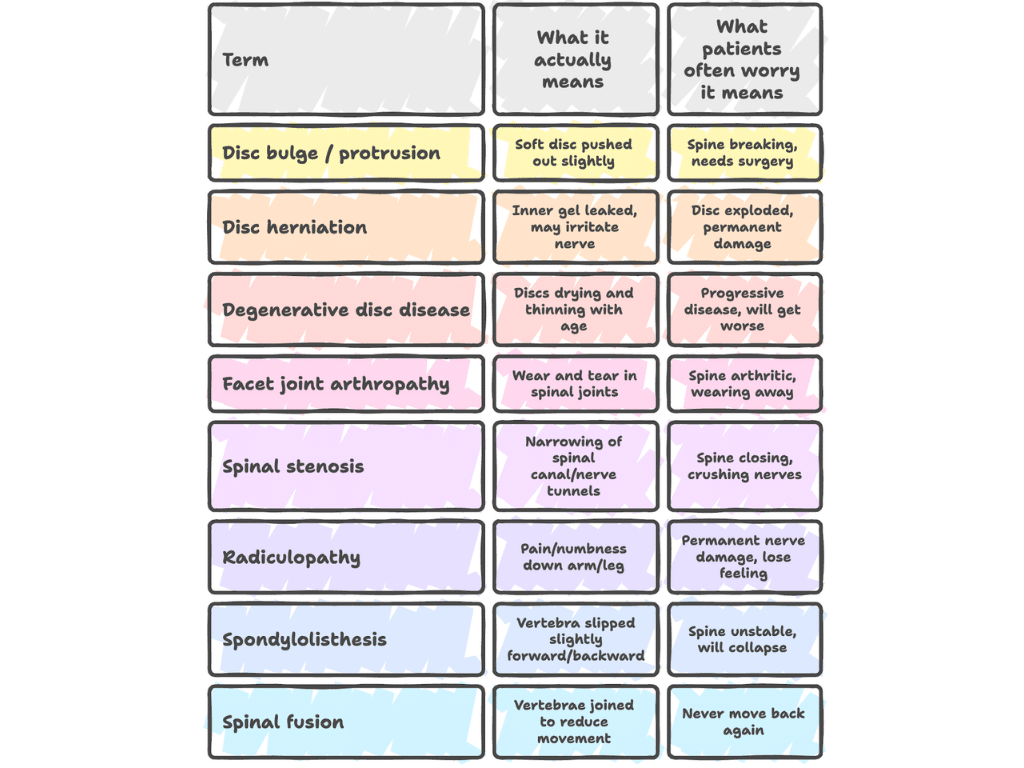
Guidelines now encourage clinicians to explain these findings in context, emphasising that many are common age-related changes that don’t always explain your pain picture. When we go through your MRI or X-ray at InSync, we link each term to your actual symptoms and your goals so the report feels understandable rather than terrifying.
Why your back actually needs to move
This is the bit that feels completely wrong when you’re in pain: your back actually needs to move. Not aggressive movement, not “work through the pain” heroics, but gentle, regular movement throughout the day.
I know what you’re thinking “but it hurts when I move.” Absolutely. And that’s exactly why people rest completely for weeks, then wonder why they feel worse and more fragile than ever.
Here’s what’s actually happening when you rest too much:
Multiple national and international guidelines highlight “stay active” and “avoid bed rest” as core recommendations across acute, ongoing and chronic low back pain. A 2024 review of low back pain guidelines showed consistent endorsement of therapeutic exercise, early return to activity, and spinal mobilisation or manipulation as part of active care. The WHO guideline similarly supports structured exercise and activity-based approaches.
This is why your physio will encourage you to walk, change position often and gradually reintroduce normal tasks, even when you still have some pain. The aim isn’t to ignore pain but to keep tissues and the nervous system moving within a safe, tolerable window so they adapt positively rather than becoming more sensitive and protective.
How we use objective data to support movement at InSync
One challenge with “stay active” advice is that it can feel vague and scary. How much is too much? How do you know you’re improving if you still hurt?
This is where technology actually helps. Using our Vald ForceDecks system, we can measure how you load each leg, how stable you are, and how your forces change as you move or hold positions. For example, we might assess how your legs share load in a squat, or how steady you are standing on one leg – both of which directly affect how your spine experiences force.
Seeing your numbers change from week to week gives you confidence that movement is helping, not harming, even if symptoms fluctuate day-to-day. It also tells us when to progress exercises and when to hold back, so your plan feels challenging but safe rather than a guessing game.
What conservative treatment actually looks like
Conservative treatment means non-surgical care, usually led in the community by physiotherapists, GPs and other allied health professionals. Most national and international guidelines recommend conservative treatment as the first-line approach for the vast majority of spine pain episodes.
What modern guidelines recommend
Recent guideline summaries from 2023–2025 emphasise:
Education and reassurance about the generally good prognosis of most back pain. Understanding what’s happening is genuinely therapeutic.
Staying active and avoiding prolonged bed rest. We’ve covered why, but it bears repeating movement is medicine for backs.
Structured, progressive exercise programmes. Including core stability, general strength work and exercises specific to your goals, whether that’s returning to manual work or playing golf.
Manual therapy as an adjunct, not a standalone. Hands-on treatment like spinal mobilisation, manipulation or soft tissue work can help, but only alongside exercise and activity.
Psychological approaches like CBT for long-standing or complex pain. Addressing unhelpful beliefs, fear-avoidance and pain-related anxiety when they’re getting in the way of recovery.
Short-term use of medicines like NSAIDs when appropriate. With clear caution about using opioids, which have poor evidence for back pain and significant risks.
For chronic primary low back pain, the WHO recommends an integrated, person-centred approach that combines exercise, education, some physical therapies and psychological support as needed. This fits well with what can be offered in a community physiotherapy setting like ours.
What this looks like in practice at InSync
When you come to see us at InSync, the first thing we do is listen. Properly. That means understanding not just where your back hurts, but what you’re actually worried about. Are you scared you won’t be able to go back to work? Worried about picking up your grandchildren? Frustrated that you can’t get through a round of golf?
Then we assess what’s actually going on. Sometimes this involves hands-on examination, sometimes it’s about watching how you move, and often we’ll use our ForceDecks system – not because we love technology for its own sake, but because seeing actual numbers on a screen helps. When you can see that your left leg is producing 30% less force than your right, or that your balance scores are improving week-on-week, it makes “getting stronger” feel real rather than abstract.
From there, we build a plan that’s yours. This typically includes:
For example, if you struggle with repeated back pain when gardening, we might first measure your lower limb strength, balance and how you load through your spine during squatting and bending. Then we build a plan that improves those areas and gradually exposes your spine to garden-like loads lifting, twisting, sustained bending. We then re-test at key points so you can see objective progress as well as feeling better.
Recovery from spinal surgery
Sometimes backs need fixing surgically – there’s no getting around it. Severe nerve compression that’s causing progressive weakness, unstable fractures, or significant stenosis that hasn’t responded to comprehensive conservative care can all require surgical intervention.
If you’ve been told you need an operation, you’re probably feeling a mix of relief (“finally, something will be done”), anxiety (“what if it doesn’t work?”) and confusion (“what happens after?”).
Here’s the reality: surgery solves the structural problem. The rehabilitation afterwards solves the functional problem getting you back to actually doing what you want to do. You can’t skip the second part and expect the first part to magically fix everything.
Typical recovery phases
Individual timelines vary enormously depending on the type of operation, your general health and your surgeon’s specific recommendations. But current practice describes broad phases that apply to most spinal procedures.
Early post-operative phase (first 2–6 weeks)
Focus is on wound healing, pain control, gentle walking and basic daily activities. Most people start short, frequent walks and simple mobility exercises within days of surgery, under guidance from the hospital physiotherapy team.
You’re not supposed to feel perfect during this phase. Some discomfort, stiffness and fatigue are normal. What you’re watching for is signs that something’s wrong dramatically increased pain, new numbness or weakness, or wound problems.
Intermediate recovery phase (6–12 weeks)
Most people gradually increase walking distance, light household tasks and return to desk-based work during this window. Some return to work earlier depending on their role and how they’re recovering.
Guided physiotherapy focuses on restoring mobility and building early strength while maintaining a neutral, protected spine position. You’re not ready for heavy lifting or high-impact activities yet, but you’re building the foundation for them.
Advanced rehab phase (3–6 months)
For many spinal fusions and more involved surgeries, this is when higher-demand activities and sport-specific training begin, provided pain is controlled and strength and range of motion are adequate.
Research in athletes suggests a high proportion return to pre-surgery sports levels between 6 and 12 months after minimally invasive lumbar procedures. For people with physically demanding jobs, this is often when return-to-work planning becomes realistic.
Long-term adaptation (6–12 months and beyond)
Bone healing and soft tissue adaptation continue well into the first year. You and your rehab team fine-tune strength, endurance and movement patterns to match your goals, whether that’s heavy manual work, hill-walking in the Cheviots or getting back on the golf course.
Recent 2025 articles on returning to daily life after spine surgery highlight the importance of a gradual, monitored increase in activity following clear guidelines rather than arbitrary timelines.
How community physio supports post-surgical recovery
Your surgeon will usually outline broad restrictions and milestones – don’t bend, lift or twist for X weeks; no driving for Y weeks; return to work discussed at your Z-week appointment. That’s helpful, but it’s not a day-to-day plan.
Community physiotherapy turns those surgeon’s instructions into a practical roadmap that fits your home, job and hobbies. At InSync, this might involve:
For example, someone returning to a physically demanding job on a farm might progress through our programme only once their strength symmetry and control under load meet specific benchmarks on ForceDecks, alongside comfortable functional testing that mirrors their work tasks. This evidence-informed approach supports a safer, more confident return to real-world demands than simply waiting a set number of weeks and hoping for the best.
How InSync Physiotherapy fits into your spine health journey
Community-based, evidence-informed care is at the heart of modern spine guidelines. In Hexham, that means having local clinicians who understand both the science and the realities of your work, family life and hobbies.
At InSync Physiotherapy, our role in spine health includes:
Whether your goal is picking up your grandchildren without hesitation, returning to the golf course, or simply getting through the workday without constantly worrying about your back, we design your plan around those outcomes. You can self-refer for an assessment, or your GP or consultant can suggest you see us as part of your care pathway.
Your questions answered
How long should I wait before seeing someone about back pain?
Here’s a simple rule: if you’ve tried the sensible things, staying gently active, using heat or ice, taking over-the-counter painkillers and you’re not seeing any improvement after about three to four weeks, that’s your signal to book in.
Don’t feel you need to be in absolute agony to “deserve” help. If your pain is significantly affecting sleep, stopping you working properly, or making you genuinely worried, book sooner rather than later. You’re not wasting anyone’s time, this is literally what we’re here for.
Seek urgent medical help immediately if you notice any of the red flag symptoms we discussed earlier bladder or bowel changes, saddle numbness, or rapidly worsening leg weakness.
Is it safe to exercise with back pain?
Almost always, yes but there’s a gap between “safe” and “sensible.” Nobody’s suggesting you deadlift 100kg when you can barely tie your shoes.
The right approach is graded exercise starting at a level that feels manageable (even if that’s just walking to the end of the road), then slowly, systematically building up. Some discomfort during exercise is normal and acceptable. Sharp, severe pain that makes you feel worse afterwards is your body’s signal to dial things back.
This is where a physio helps, because we can judge what “challenging but safe” looks like for you specifically, rather than you guessing and either doing too much (and scaring yourself) or too little (and not progressing).
Do I need an MRI scan before starting physiotherapy?
In most cases, especially early on, no. You don’t need a scan before beginning evidence-based conservative treatment.
Scans are reserved for specific situations: when you have red flag signs suggesting serious pathology, when good conservative care has failed after an appropriate trial period, or when surgery is genuinely being considered and the surgeon needs anatomical detail.
Getting a scan too early can actually be counterproductive. You end up with a report full of “abnormal” findings that are completely normal for your age, which increases anxiety and can lead to unnecessary procedures. We’d much rather assess how you move, how strong you are, and how your pain behaves, then build a treatment plan from there.
If we think you genuinely need imaging, we’ll tell you and help coordinate that through your GP or consultant.
How long does recovery after spinal surgery really take?
The honest answer is: it depends enormously on the procedure, your health going into surgery, and your rehab afterwards.
Simple keyhole procedures might allow return to light activities within a few weeks. More involved operations like fusions often require several months for comfortable function and six to twelve months for full recovery and return to high-demand tasks like heavy manual work or competitive sport.
Working with a physio helps you tailor milestones to your specific surgery, health status and goals rather than relying only on generic timelines. We use objective measures to tell when you’re ready to progress, not just arbitrary dates on a calendar.
The other reality is that “recovery” doesn’t mean you’ll feel exactly like you did before you had any back problems. It means getting back to doing the things that matter to you with manageable symptoms and good function. For many people, that’s a significant improvement on where they were pre-surgery, even if they’re not quite back to being twenty years old.
What’s the most important thing I can do today for my spine health?
The single most important step is to keep moving within your comfort window and avoid long periods of complete rest. Even if that’s just getting up from your chair every half hour to walk around, or taking a short walk around the block, movement matters.
Add to that: build strength gradually when you’re ready, prioritise good sleep (easier said than done when you’re in pain, I know), and ask for help early if pain is limiting your life or worrying you. Don’t wait until you’re desperate before seeking advice.
And perhaps most importantly: try not to catastrophise about what’s happening in your back. Most back pain, even severe back pain, improves with time and appropriate care. Your spine is usually much more robust than it feels when you’re hurting.
Need help with your spine health?
If you’re in Hexham or the surrounding Tyne Valley area and your back or neck pain isn’t settling as you’d hoped, we’re here to help. Book an assessment at InSync Physiotherapy and we’ll give you a clear understanding of what’s happening, what you can do about it, and a practical plan to get you back to the things that matter.
You can self-refer directly, or ask your GP to recommend us as part of your care. Call us or book online to get started.
Ready to Start Your Recovery?
Whether you’re recovering from surgery, dealing with a sports injury, or just want to feel like yourself again, our expert physiotherapists are here to support you.
Based in Hexham, serving the wider Tyne Valley including Greenhead, Bellingham, Allendale, Matfen and surrounding areas.
Sara Mather.
Founder of InSync
Hexham