Acupuncture for migraines has a stronger evidence base than many people expect. NICE recommends it, a large Cochrane review supports it, and at InSync Therapy in Hexham we offer it as part of a full physiotherapy assessment. It helps some people, though not everyone, and it is not a cure.
This guide explains what the evidence actually says and what NICE recommends. It also shows where acupuncture fits alongside physiotherapy. We have written it for adults across Hexham, Northumberland and the Tyne Valley who live with regular migraines.
Can acupuncture help with migraines?
Yes, acupuncture can reduce how often migraine attacks happen for some people. The best evidence supports it as a preventive treatment, not as a quick fix during an attack.
Migraine is more than a bad headache. It is a neurological condition. Attacks often bring throbbing pain, nausea and sensitivity to light or sound. Some people also get aura, such as flashing lights, before the pain starts.
Acupuncture does not switch migraine off. Instead, a course of treatment may reduce the number of attacks you have each month. For many people, fewer migraine days means fewer missed shifts and cancelled plans. It can also mean less reliance on painkillers.
Results vary, though. Some people notice a clear change within a few weeks. Others notice very little. That is why we set clear goals and review progress with you at every stage.
What does NICE say about acupuncture for migraines?
NICE recommends considering acupuncture for migraines when preventive medicines have not worked or are not suitable. The guideline suggests up to 10 sessions over 5 to 8 weeks.
NICE is the National Institute for Health and Care Excellence. Its headache guideline (CG150) guides NHS care across England. It lists three preventive medicines first: propranolol, topiramate and amitriptyline. If these fail, cause side effects or are unsafe for you, NICE says acupuncture is an option.
This matters for two reasons. First, it shows acupuncture has earned a place in UK clinical guidance. Second, it sets a realistic dose. One session is unlikely to tell you much. In contrast, a structured course gives it a fair trial.
NICE also recommends a headache diary. We ask patients to keep one before and during treatment. As a result, we can measure change rather than guess at it.
What does the research actually show?
Research shows acupuncture for migraines reduces attack frequency more than no treatment, and slightly more than sham acupuncture. It also appears to work about as well as some preventive drugs, with fewer side effects.
The strongest summary comes from a 2016 Cochrane review. Cochrane reviews pool the results of many trials. This one included 22 trials and almost 5,000 people with episodic migraine. Here is what it found, in plain terms.
Acupuncture versus no preventive treatment
When people added acupuncture to their usual care, about 41 in 100 halved their migraine frequency. By comparison, about 17 in 100 did so without it. That is a meaningful difference.
Acupuncture versus sham acupuncture
Sham acupuncture uses fake or shallow needling. In these trials, about 50 in 100 people improved with real acupuncture. Meanwhile, about 41 in 100 improved with sham. So the gap is small.
This tells us that expectation, relaxation and time with a clinician all play a part. Even so, real acupuncture still performed slightly better.
Acupuncture versus preventive medication
The review found acupuncture worked at least as well as some preventive drugs. In addition, fewer people stopped acupuncture because of side effects. This is important if you cannot tolerate medication.
The limits of the evidence
Many trials were small, and it is hard to hide from patients whether they had real needles. Also, the Migraine Trust notes the evidence is stronger for episodic migraine than for chronic migraine. Chronic migraine means headaches on 15 or more days a month.
How does acupuncture for migraines work?
Nobody fully knows how acupuncture for migraines works. The leading theory is that needling changes how the nervous system processes pain.
Research suggests needling may trigger the release of natural pain-relieving chemicals, such as endorphins. It may also calm overactive pain pathways in the brainstem and upper neck. These pathways play a role in migraine.
Acupuncture can also ease muscle tension in the neck and shoulders. Furthermore, many people find sessions deeply relaxing. Because stress is a common migraine trigger, this may help too.
At InSync Therapy, our physiotherapists use a Western medical approach to acupuncture. This means we base it on anatomy and neurophysiology. We explain every point we use and why.
What happens during an acupuncture session at InSync Therapy?
Your first appointment starts with a full assessment, not needles. We need to understand your migraines before we treat them.
First, we ask about your attack pattern, triggers, medication and general health. Next, we assess your neck, jaw, posture and shoulder movement. Then we agree together whether acupuncture suits you.
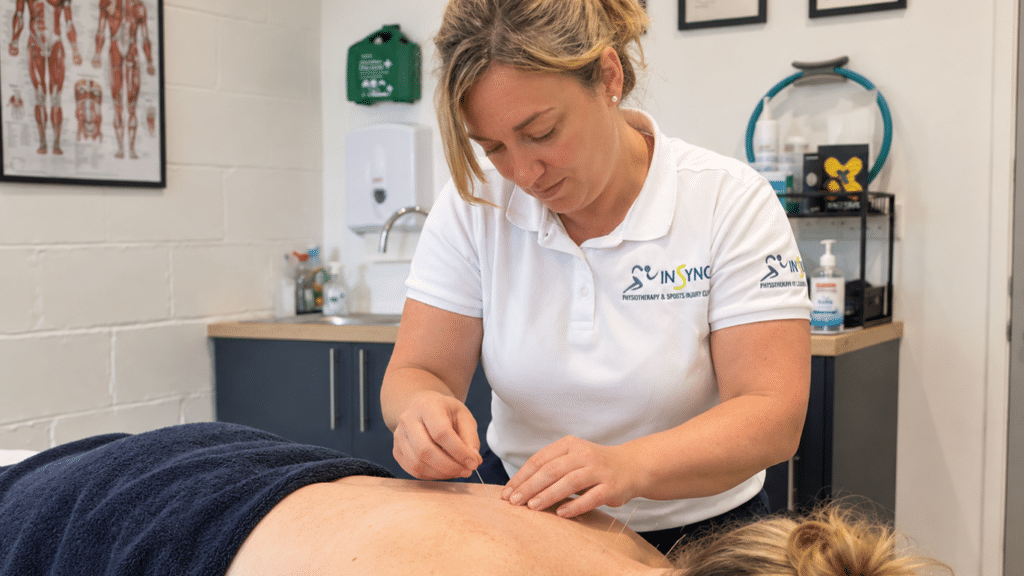
If it does, treatment is simple. We insert fine, single-use sterile needles at chosen points. Common areas include the neck, shoulders, hands and feet. Needles usually stay in for 15 to 30 minutes.
Most people feel a dull ache or tingle rather than sharp pain. Side effects are usually mild and short-lived. They include slight bruising, soreness or tiredness afterwards. Serious problems are rare when a trained practitioner treats you.
For this reason, always choose a chartered physiotherapist or other registered clinician with recognised acupuncture training.
Is acupuncture right for you?
Acupuncture for migraines suits many adults with frequent attacks, especially those who want to rely less on medication. However, it is not right for everyone, and some headaches need urgent medical care first.
Acupuncture may be a good fit if you:
Tell us before treatment if you are pregnant or take blood thinners. Also mention a bleeding disorder, a pacemaker or a fear of needles. In these cases, we may adjust treatment or suggest another option.
When to see a doctor urgently
Some headaches need a medical check, not physiotherapy. Call 999 or go to A&E if you have:
See your GP if headaches start after the age of 50, or if your pattern changes suddenly. The NHS migraine pages offer clear guidance on symptoms and treatment.
How does physiotherapy help migraines beyond acupuncture?
Physiotherapy targets the neck, movement and lifestyle factors that often feed into migraine. For this reason, acupuncture usually works best as one part of a wider plan.
| From our Hexham clinicIn our Hexham clinic, many people who come to us with migraines also have long-standing neck and shoulder stiffness. They are often desk workers, drivers commuting on the A69, or parents lifting young children. Most have never linked the two.When we treat the neck alongside acupuncture, patients often notice fewer tension-type headaches mixed in with their migraines. As a result, their true migraine pattern becomes easier to see and manage. |
Alongside acupuncture, we may use:
We also watch for medication overuse headache. This can develop if you take painkillers on many days each month. If we suspect it, we will ask you to speak to your GP.
Where can you get acupuncture for migraines in Hexham?
InSync Therapy offers acupuncture for migraines in Hexham as part of a full physiotherapy assessment. A structured assessment is the best first step if migraines are limiting your life.
We see patients from Hexham, Corbridge, Haltwhistle, Prudhoe and across Northumberland. We offer acupuncture, physiotherapy, clinical Pilates and exercise therapy under one roof. Therefore, your care stays joined up.
Before you book, speak to your GP if you do not yet have a formal diagnosis. Then start a headache diary. Finally, bring it to your first appointment, along with a list of your current medicines. Find out more about acupuncture at InSync Therapy [/services/acupuncture/].
Frequently asked questions
Sources
- NICE (2012, updated 2025). Headaches in over 12s: diagnosis and management (CG150).
- Linde K, et al. (2016). Acupuncture for the prevention of episodic migraine. Cochrane Database of Systematic Reviews, CD001218.
- The Migraine Trust. Acupuncture for migraine.
- NHS. Migraine.
This article is for general information. It does not replace advice from your GP or a qualified clinician.
Ready to Start Your Recovery?
Whether you’re recovering from surgery, dealing with a sports injury, or just want to feel like yourself again, our expert physiotherapists are here to support you.
Based in Hexham, serving the wider Tyne Valley including Greenhead, Bellingham, Allendale, Matfen and surrounding areas.
Sara Mather.
Founder of InSync
Hexham