You pick up a mug and feel it.
Open a jar and feel it again.
Carry a shopping bag, use secateurs in the garden or lift a pan from the hob, and suddenly your elbow reminds you that something isn’t quite right.
Tennis elbow can make surprisingly ordinary movements painful. Yet the problem isn’t usually that your elbow has suddenly become fragile. More often, the demands being placed on the tissues around the elbow have temporarily exceeded what they are able to tolerate.
That is why simply resting the arm can make things feel better without necessarily getting you back to normal.
The longer-term aim is to rebuild the arm’s capacity so that gripping, lifting, twisting and everyday activities become comfortable again.
What tennis elbow actually is
Tennis elbow is more accurately called lateral elbow tendinopathy. It causes pain around the outside of the elbow, where tendons from the muscles of the forearm attach near the bony prominence of the elbow.
Those muscles help control your wrist and fingers. They are also heavily involved whenever you grip, lift, carry or twist something.
Despite the name, tennis is not usually the reason someone develops it. Lateral elbow tendinopathy can develop after a change in activity, repetitive work, manual tasks, gardening, DIY, computer use or any other activity that places more demand on the forearm than it has been used to handling.
The word “tendinopathy” is useful because it moves us away from thinking of the problem simply as inflammation. Tendons can become painful and sensitive when their ability to tolerate load changes, and the tendon and surrounding tissues may go through structural and functional changes over time.
That distinction matters because the answer is not necessarily to keep the arm completely still until everything has “healed”.
Why does gripping hurt so much?
Gripping seems like a simple movement, but it involves a surprisingly large amount of work from the muscles of your forearm.
When you squeeze a mug handle, carry a bag or turn a screwdriver, the muscles controlling your fingers and wrist contract. Their tendons attach around the outside of the elbow, so force generated further down the arm is transmitted through the area that is already sensitive.
The same thing happens when you twist.
Opening a stubborn jar, turning a door handle or using a screwdriver combines gripping with rotation of the forearm. That combination can be particularly provocative when the tissues around the outside of the elbow are irritable.
This is why someone can have relatively little discomfort while sitting still but quite a lot when carrying something.
It is not necessarily the weight of the object alone that matters. The position of your wrist, how firmly you grip, how long you hold something and how often you repeat the movement all contribute to the total load.
A half-full kettle lifted once may be manageable.
A lighter object lifted fifty times may not be.
That is one reason tendon problems can sometimes seem confusing. The painful movement isn’t always the heaviest thing you do.
You don’t have to play tennis to develop tennis elbow
The name has probably caused more confusion than anything else about this condition.
Tennis and other racket sports can certainly place a lot of demand on the forearm, particularly when gripping the racket and repeatedly hitting the ball. But most people with tennis elbow are not competitive tennis players.
Repetitive gripping and twisting can come from many parts of everyday life.
You might notice symptoms after:
The common thread is usually a change in demand rather than one particular activity.
Sometimes there isn’t an obvious trigger at all. The symptoms may build gradually until you realise that opening a jar or lifting your laptop has started to hurt.
Why stopping everything can make sense at first but isn’t the whole answer
When an activity hurts, reducing it is sensible.
If gripping, lifting or twisting repeatedly aggravates your elbow, temporarily doing less of it gives the irritated tissues a chance to settle. You may need to change how you perform certain tasks, take more breaks or use your other arm for some activities.
But there is a difference between reducing an aggravating load and avoiding load altogether.
If you stop using the arm for a prolonged period, the muscles can lose strength and the tissues become less accustomed to everyday demands. When you eventually return to normal activity, the same load may feel surprisingly difficult.
This is where people can get caught in a cycle:
Pain → stop using the arm → strength and tolerance reduce → normal activity feels harder → pain returns → stop again.
The aim of rehabilitation is to break that cycle.
You don’t need to force your way through painful activities. Instead, the arm needs an appropriate amount of work that can be gradually increased.
Tendon capacity is part of the story
Think of tendon capacity as the amount of work your arm can comfortably tolerate.
That capacity isn’t fixed.
It can increase when the tissues are exposed to appropriate, progressive loading. It can also temporarily fall when activity changes, strength decreases or the demands placed on the arm increase faster than the tissues can adapt.
For example, imagine someone who has spent several months doing very little DIY. They then decide to renovate a room over a weekend.
The forearm may suddenly be doing hours of gripping, drilling, sanding and twisting. Even if each individual movement is something the arm has managed before, the overall dose is very different.
The problem isn’t necessarily that the person has “damaged” their elbow by using it.
The problem may be that the workload has jumped beyond the arm’s current capacity.
This load-versus-capacity relationship is one of the most useful ways to understand why symptoms develop and why rehabilitation needs to be progressive.
So how do you build the arm back up?
Strengthening for tennis elbow isn’t about finding one magic exercise.
The starting point depends on how irritable the elbow is, how strong the arm currently is and what you need to return to.
Early rehabilitation might involve gentle, controlled contractions of the wrist and forearm muscles. As the arm becomes more comfortable, resistance can gradually increase.
Exercises may include:
Wrist extension
The muscles that lift your wrist are closely involved in tennis elbow. Controlled wrist extension against resistance can gradually increase their capacity.
Forearm rotation
Turning the palm up and down against resistance helps prepare the arm for movements such as using tools, turning handles and opening jars.
Grip strengthening
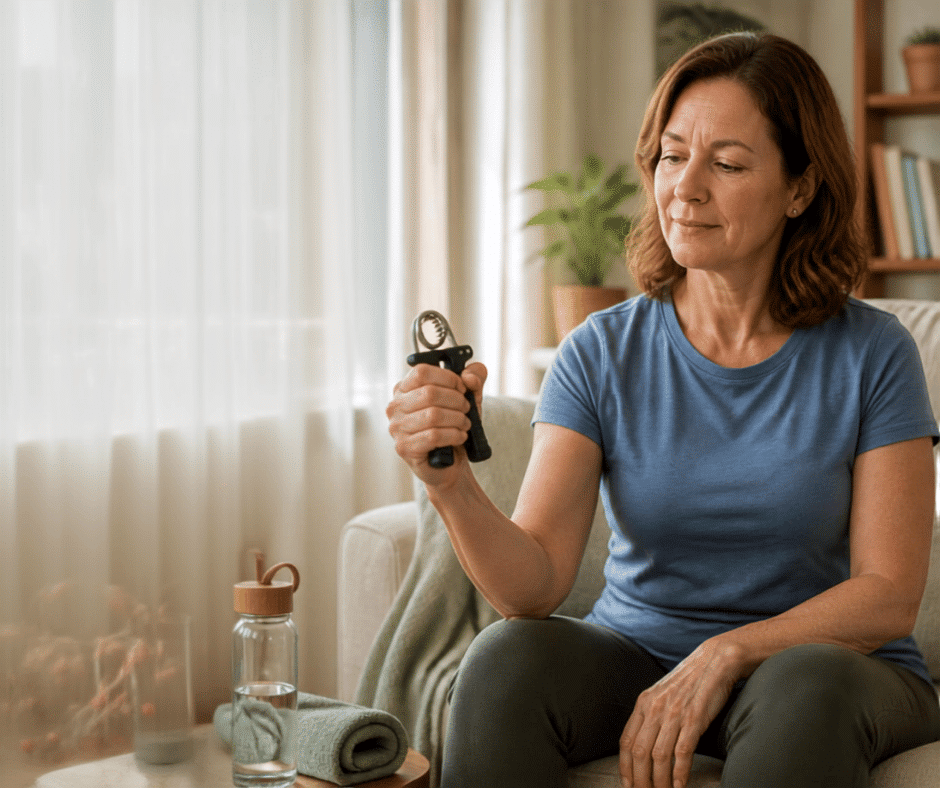
Grip work can be useful, but it needs to be introduced at an appropriate stage. If squeezing a ball hard is very painful, that isn’t necessarily the best place to start.
Whole-arm strengthening
Your elbow doesn’t work in isolation. Shoulder, upper-arm and forearm strength all contribute to how forces are managed through the arm.
The Chartered Society of Physiotherapy provides exercises including wrist extension, wrist flexion, forearm rotation and elbow strengthening for people with elbow pain.
The important part isn’t simply doing the exercise.
It is progressing it.
Progression matters more than finding the perfect exercise
A tendon does not know whether you are holding a dumbbell, resistance band or tin of beans.
It responds to the load being placed through it.
That means an exercise that initially feels challenging may eventually become easy. When that happens, continuing to perform exactly the same movement with exactly the same resistance may no longer provide enough stimulus to improve capacity.
Progression might mean:
The progression should match the person’s symptoms and goals.
Someone whose main problem is opening jars may need a different end point from someone who needs to return to manual work, tennis or weight training.
Some discomfort during rehabilitation isn’t automatically a sign that you are causing damage. The response afterwards matters too. If an exercise produces a substantial or prolonged flare-up, the dose may be too high and needs adjusting.
This is one of the reasons an individualised programme can be more useful than simply being handed a list of elbow exercises.
What if you are worried because your grip feels weak?
Grip weakness can occur alongside tennis elbow.
Sometimes this is genuine loss of strength. Sometimes gripping hurts so much that the nervous system naturally reduces how hard you are willing to squeeze.
That distinction matters.
If you are struggling to hold everyday objects, repeatedly dropping things, or noticing significant weakness that doesn’t seem to be explained by pain, an assessment is worthwhile. Not every problem around the outside of the elbow is tennis elbow, and a physiotherapist can assess the neck, shoulder, elbow, wrist and nerves as well as the painful area.
A good assessment isn’t just about finding the sore spot.
It is about understanding why that particular load is provoking symptoms and what needs to change.
When is tennis elbow worth getting assessed?
Many cases improve with time, activity modification and appropriate exercise. But you don’t have to wait indefinitely if the problem is affecting your life.
Consider an assessment if:
NHS guidance advises seeking medical advice if elbow pain persists after a period of self-care, while physiotherapy is one of the options that may be considered when symptoms do not settle.
You should seek more urgent medical advice if elbow or arm pain follows a significant injury, particularly if there was a snap, the arm looks different, movement is severely restricted, or you develop numbness or tingling.
What does recovery realistically look like?
This is where tennis elbow can be frustrating.
Recovery is rarely a straight line.
You may have a good week followed by a flare-up after doing more gardening, decorating or lifting than usual. That does not automatically mean you have undone all your progress.
The more useful question is whether your overall capacity is improving.
Can you now lift a heavier mug without thinking about it?
Can you open a jar more easily?
Can you work for longer before the elbow complains?
Can you do your exercises with more resistance?
Can you return to your hobby with fewer symptoms?
Those functional changes tell you much more than whether the elbow feels perfect every morning.
Lateral elbow tendinopathy often settles gradually rather than overnight. NHS and NHS physiotherapy resources note that symptoms can persist for months, and some cases take considerably longer to fully resolve.
That doesn’t mean you should simply put up with it.
It means the rehabilitation target is not necessarily “zero pain immediately”. It is to steadily improve comfort, strength and tolerance until the arm can cope with the things you need and want to do.
Tennis elbow physiotherapy in Hexham
If elbow pain is making everyday gripping and lifting difficult, an assessment can help work out what is driving the symptoms and how much load your arm can currently tolerate.
At InSync Therapy in Hexham, physiotherapy assessment can look at the elbow alongside wrist, forearm, shoulder movement, strength and the activities that are provoking your symptoms. From there, rehabilitation can be progressed around your actual goals rather than simply treating the painful spot.
That might mean getting back to gardening, being able to work comfortably, returning to the gym or simply picking up your favourite mug without thinking twice about it.
You don’t need to be a tennis player to have tennis elbow and you don’t necessarily need to stop using your arm to get better.
The aim is to build it back up.
Frequently Asked Questions
Ready to Start Your Recovery?
Whether you’re recovering from surgery, dealing with a sports injury, or just want to feel like yourself again, our expert physiotherapists are here to support you.
Based in Hexham, serving the wider Tyne Valley including Greenhead, Bellingham, Allendale, Matfen and surrounding areas.
Sara Mather.
Founder of InSync
Hexham