An ankle sprain is the most common sports injury we treat at InSync Therapy. Rugby, football, cricket, tennis and running all produce them in numbers, and most follow the same story. The player hobbles to the sideline, ices the ankle, and tries to “walk it off” over the following days.
That instinct feels sensible. It is also the main reason so many ankles never recover properly. Research suggests up to 40% of people who sprain an ankle go on to develop long-term problems. Most of those problems are preventable with the right early care.
This guide explains what happens inside the joint, why the old RICE advice no longer stands, and the five steps that restore strength and stability. It is written for players and active adults across Hexham, the Tyne Valley and wider Northumberland.
Why is “walking it off” the worst thing you can do for an ankle sprain?
Walking on a freshly sprained ankle before it has been assessed can turn a mild ligament injury into a long-term instability problem. In the first few days, the damaged ligament needs protection, not repeated loading it cannot yet control.
“Walking it off” usually means limping. Limping changes how you load every joint from the foot to the hip. It also keeps stressing ligament fibres that are trying to knit back together. The result is a ligament that heals long, loose and poorly organised.
There is a second problem. Pain settles faster than tissue heals. Many people feel fine at two weeks and return to sport on a ligament that is nowhere near ready. That mismatch is exactly where re-sprains and chronic instability begin.
What happens to your ligaments when you sprain your ankle?
An ankle sprain stretches or tears one or more of the ligaments that hold the joint stable. In most cases, the injury affects the anterior talofibular ligament (ATFL) on the outside of the ankle, damaged when the foot rolls inwards under you.
Ligaments are strong bands of tissue that connect bone to bone. They do two jobs. First, they physically restrain the joint. Second, they feed your brain constant information about the ankle’s position. That second job is called proprioception, and it decides whether you sprain the same ankle again.
When a ligament tears, both jobs are disrupted. Swelling and bleeding follow, then a repair phase in which new collagen fibres are laid down. Those fibres organise along the lines of load you place through them. Controlled movement builds a strong, orderly repair. No movement, or chaotic painful movement, builds a weak one.
What are the three grades of ankle sprain?
Ankle sprains are graded from 1 to 3 based on how much ligament damage has occurred. The grade sets your recovery timeline and how much early protection the ankle needs.
Accurate grading matters because it changes the plan. A grade 3 sprain managed like a grade 1 rarely ends well. This is one of the first things we establish at assessment.
Is RICE still the right way to treat an ankle sprain?
No. RICE — rest, ice, compression, elevation — is outdated advice for ankle sprains. Current evidence supports a newer framework called PEACE and LOVE, which prioritises protection and early movement over prolonged rest and ice.
The problem with RICE sits in the R and the I. Complete rest weakens the muscles around the joint and lets your balance sense fade. Ice numbs pain, but there is little evidence it speeds healing. Some research suggests that prolonged icing may even blunt the early inflammatory response the tissue needs to repair.
PEACE and LOVE takes a different approach. In the first days: Protect, Elevate, Avoid anti-inflammatories, Compress and Educate. From there: Load progressively, stay Optimistic, promote blood flow (Vascularisation) and Exercise. NHS guidance now reflects the same shift, advising gentle movement as soon as pain allows rather than complete rest.
Why does functional movement beat complete rest?
Controlled, progressive movement helps ligament fibres heal in an organised pattern and keeps the muscles and balance systems around the ankle working. Complete rest produces a weaker repair and a slower, riskier return to sport.
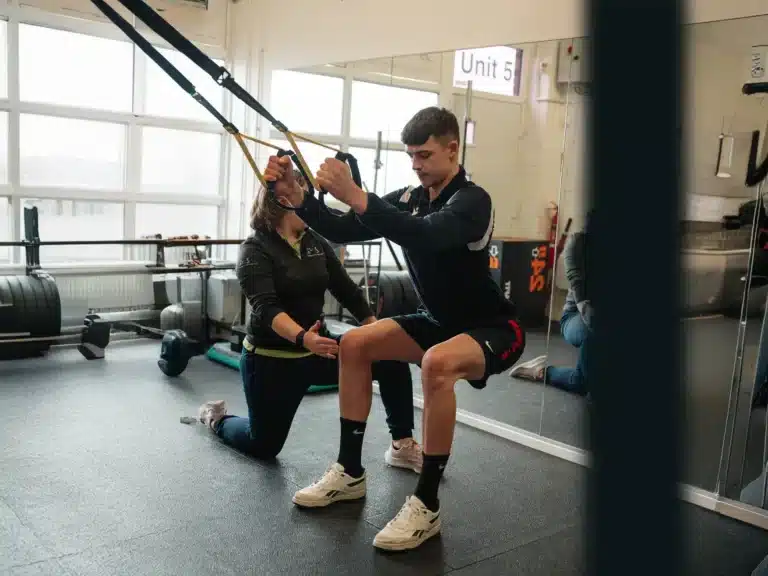
Good rehabilitation moves through clear stages. First, restore normal range of movement. Second, rebuild strength in the calf and the peroneal muscles that guard the outside of the ankle. Third, retrain balance with single-leg work. Finally, add sport-specific loading such as hopping, landing and changing direction.
Functional does not mean pushing through pain. Mild discomfort during exercise is acceptable. Sharp pain, or swelling that increases overnight, means the load was too much. A physiotherapist’s job is to keep you in that productive middle zone.
What happens if an ankle sprain is under-treated?
Under-treated ankle sprains commonly progress to chronic ankle instability — a pattern of repeated giving way, recurrent sprains and lasting distrust of the joint. Studies suggest this affects up to 40% of people after a first sprain.
The mechanics are predictable. The ligament heals long and loose. Balance sense is never retrained. The peroneal muscles never regain full strength. Each re-sprain then adds new damage, and over years, repeated sprains raise the risk of ankle osteoarthritis.
| FROM THE CLINIC — first-hand observationIn our Hexham clinic, we regularly see rugby and football players from Tyne Valley clubs who tell us they have sprained the same ankle “four or five times” since school. Almost none of them completed rehabilitation after the first injury. By the time they reach us, the problem is rarely the ligament itself. It is years of untrained balance and strength that we have to rebuild from the ground up. |
When can you return to sport after an ankle sprain?
Most people return to sport between two and twelve weeks after an ankle sprain, depending on the grade. Readiness should be judged on tests, not on the calendar.
Before we clear a player for full training, we want to see four things. A full, pain-free range of movement. Calf strength within roughly 90% of the other side. Steady single-leg balance with eyes closed, plus pain-free hopping and change of direction.
Sport matters too. Rugby and football demand cutting and contact. Cricket loads the ankle through the bowling stride. Tennis lives on lateral lunges. Runners need a graded return to distance. We match the final stage of rehabilitation to the sport you are going back to.
Ankle sprain treatment at InSync Therapy in Hexham

InSync Therapy provides assessment, accurate grading and structured rehabilitation for ankle sprains at our clinic in Northumberland. We offer ankle sprain treatment Hexham patients can access within days, with no GP referral needed.
Assessment starts with your history and hands-on ligament testing. We screen for fracture using established clinical criteria and refer for imaging if anything does not add up. You then leave with a five-step plan: accurate grading, early protection, progressive loading, balance retraining and return-to-sport testing. Our Pilates and exercise therapy sessions support the later stages.
For grade 2 and 3 sprains, early protection sometimes means a walker boot for a short period. It lets you stay on your feet without limping while the ligament begins to heal, and it is set aside as soon as the ankle can tolerate controlled loading.
Whether the injury happened at the weekend or your ankle has been giving way for years, the starting point is the same. Book an assessment and find out exactly what you are dealing with.
Ankle sprain FAQs
Ready to Start Your Recovery?
Whether you’re recovering from surgery, dealing with a sports injury, or just want to feel like yourself again, our expert physiotherapists are here to support you.
Based in Hexham, serving the wider Tyne Valley including Greenhead, Bellingham, Allendale, Matfen and surrounding areas.
Sara Mather.
Founder of InSync
Hexham