Golf looks gentle from the outside. A steady walk, a smooth swing, fresh air.
But ask any golfer who has spent weeks off the course with a stiff lower back, a painful hip, or a wrist that won’t settle. The forces running through your body during a golf swing are significant. Over 18 holes, you repeat that movement dozens of times. Over a season, hundreds.
When something hurts, most golfers rest, stretch, or push through. Some book a physiotherapy appointment. That can absolutely help. But if your assessment never looks at how you actually swing a golf club, the pain almost always comes back.
That is exactly what a TPI golf assessment is designed to address.
What Is a TPI Golf Assessment?
TPI stands for Titleist Performance Institute. It is a globally recognised framework used by physiotherapists, strength coaches and movement specialists who work with golfers at every level.
The assessment looks at your body, not just your symptoms.
It screens 16 physical attributes that directly affect how you move through the golf swing. Hip mobility. Thoracic rotation. Shoulder stability. Core control. The ability to separate your upper and lower body through the downswing.
These are the movement foundations of a safe, efficient swing.
When one of them is limited, your body compensates. If your hips don’t rotate freely, your lower back takes the load. If your thoracic spine is stiff, your shoulders overwork. The body always finds a way through. But that workaround has consequences.
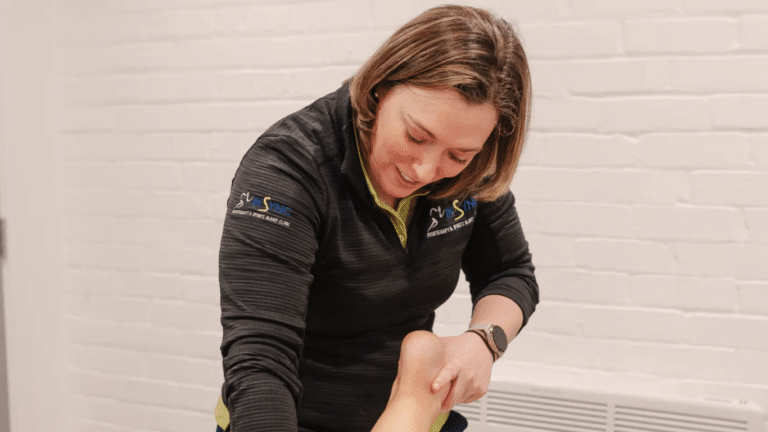
At InSync Therapy in Hexham, we use the TPI golf assessment to identify exactly where those compensations are happening and why. That changes how we treat you.

The Most Common Golf Injuries We See
Lower Back Pain
Lower back pain is the most common complaint among golfers at every level. The golf swing generates significant compressive and rotational forces through the lumbar spine. When hip mobility or core stability is limited, the lower back absorbs more load than it should.
Rest usually settles it. But without understanding the movement pattern behind it, the same stress returns the moment you pick up a club again.
Hip Pain
The hips need to rotate, load and stabilise through every phase of the swing. When mobility is reduced or the surrounding muscles are weak, the joint works harder than it should. This can lead to tendon irritation, impingement or a deep ache that builds quietly across a season.
Many golfers are told their hip pain is wear and tear. Sometimes that is true. But the movement demands of golf mean that how you use the hip matters just as much as what the scan shows.
Lead Wrist Pain
Pain at the lead wrist, your left if you play right-handed is especially common in regular golfers. It tends to develop gradually and can point to issues with grip mechanics, forearm loading or how forces are transmitted through the clubface at impact.
Treating the wrist in isolation often helps short-term. Understanding why it is overloading in the first place gives you a longer-term solution.
Shoulder Pain
Rotator cuff irritation and shoulder impingement are frequent in regular golfers. The follow-through places particular demand on the trail shoulder, and the lead shoulder works hard through the backswing. Both are vulnerable when thoracic mobility is restricted. When the mid-back cannot rotate freely, the shoulders compensate. Over time, that compensation adds up.
Why the Injury Keeps Coming Back
This is the question that matters most to the golfers we see at InSync Therapy.
You rest. The pain settles. You return to golf. Six weeks later you are back in the same position.
The reason is usually straightforward: the underlying movement limitation was never identified or addressed. Your body adapted around it during your swing. And it will keep adapting, in the same way, producing the same strain, until someone examines how the two things connect.
A physiotherapist can treat damaged tissue and reduce pain effectively. But without understanding what is happening in your swing, they are working with half the picture. The TPI assessment gives us the rest.
What to Expect From a TPI Golf Assessment at InSync Therapy
Your session begins with a detailed conversation. We want to understand your pain, your playing history, how often you play and what you have already tried.
Then we move into the physical screen.
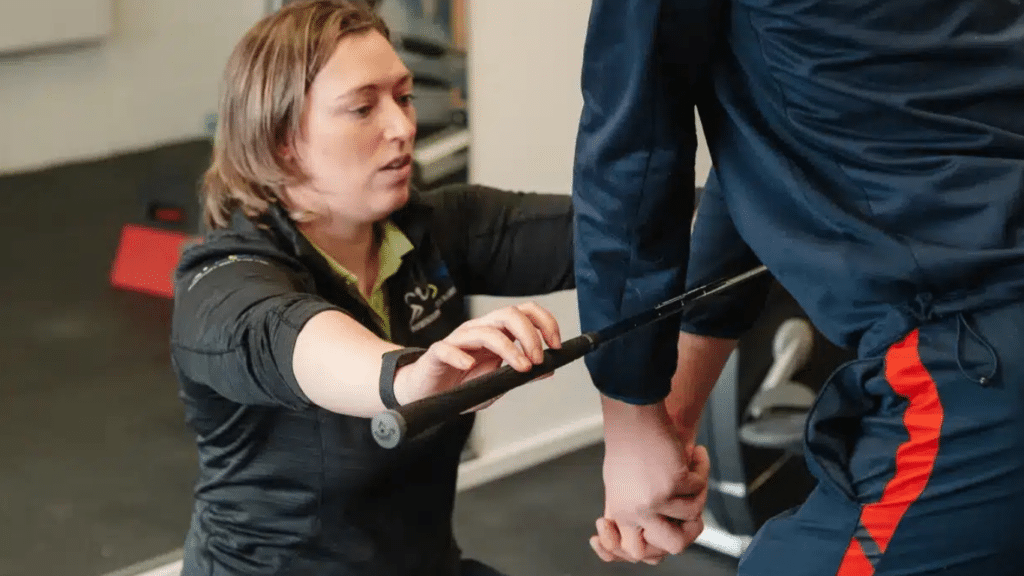
We assess how your body moves through the patterns most relevant to the golf swing. We identify where your range is restricted, where it is excessive and where compensation is occurring. We look at how your joints load, how your segments connect and where control breaks down under demand.
After the assessment, you will have a clear picture of what is limiting your swing and contributing to your pain. You leave with a targeted plan: the right exercises, the right rehabilitation, and guidance you can take to your coach if a swing adjustment is part of the solution. Find out more about the TPI golf assessment at InSync Therapy.
We work alongside golf coaches across the Tyne Valley and Northumberland. Where it helps, we coordinate directly. Your body and your swing need to work together. That is how lasting improvement happens.
Who Is This Assessment For?
You do not need to be an elite player or a scratch handicapper to benefit from a TPI assessment.
It works well for:
At InSync Therapy in Hexham, we regularly see golfers who play across Northumberland and the Tyne Valley. Many have had previous treatment. Many have been told to rest and strengthen. What they have not received is a clear explanation of why the problem keeps returning.
That is precisely what the TPI golf assessment provides.
Treat the Problem, Not Just the Pain
Golf injuries are rarely just about tissue damage. They are about how a demanding, repetitive movement pattern interacts with the particular limitations of your body on any given day.
Treat only the tissue, and you manage the symptom. Understand the movement, and you address the cause.
If you are managing a recurring golf injury, or you want to understand your body before the next problem develops, a TPI golf assessment at InSync Therapy in Hexham is a practical and targeted place to start.
Book your TPI golf assessment here.
Ready to Start Your Recovery?
Whether you’re recovering from surgery, dealing with a sports injury, or just want to feel like yourself again, our expert physiotherapists are here to support you.
Based in Hexham, serving the wider Tyne Valley including Greenhead, Bellingham, Allendale, Matfen and surrounding areas.
Sara Mather.
Founder of InSync
Hexham