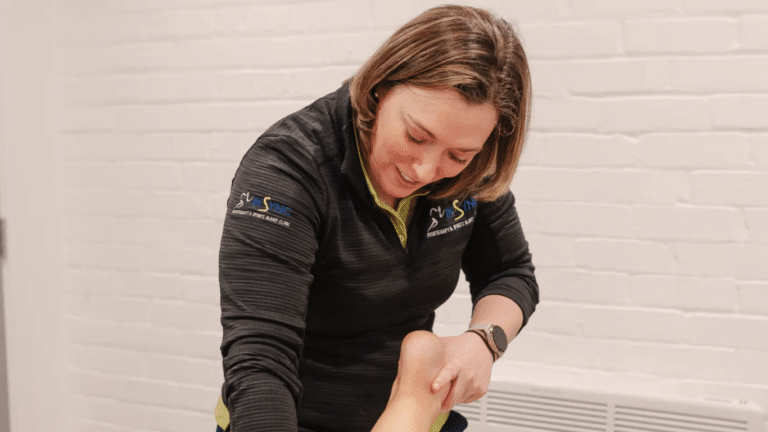
Hip pain that lingers is one of the most common problems we see at InSync Therapy. If you have been managing hip pain in Hexham or the Tyne Valley for weeks or months, you will know how frustrating it can be. Especially when rest does not seem to help.
What makes it worse is not knowing why it has not settled. You ease off, you wait, and the moment you return to normal activity walking the dog, getting back to the gym, returning to sport the pain comes straight back.
In most cases, that cycle has a clear explanation. Hip pain rarely resolves without addressing its cause. The weakness, the movement pattern, the joint stiffness these things do not fix themselves with time alone. Understanding what is driving your pain is the first step toward changing it.
4 Causes of Hip Pain That Won’t Go Away
Several conditions sit behind persistent hip pain. They are all manageable with the right assessment and treatment plan. They also frequently overlap, which is why a structured assessment matters more than guessing based on symptoms alone.
1. Hip Bursitis
Bursae are small fluid-filled sacs that cushion the hip joint and the tendons that cross it. When they become inflamed a condition known as bursitis you will typically feel pain on the outer hip or buttock. It often worsens at night, when lying on the affected side, or after prolonged walking or standing.
What many people do not realise is that rest rarely resolves hip bursitis for good. The inflammation may settle, but the root cause almost always a weakness in the gluteal muscles remains unchanged. Without addressing that imbalance, the bursitis returns.
Hip bursitis is one of the most common types of hip pain we treat in Hexham. With a targeted rehabilitation programme, most patients see significant improvement within six to eight weeks.
2. Hip Flexor Tightness
The hip flexors sit at the front of the hip and shorten with prolonged sitting. When they are tight, they pull the pelvis forward into an anterior tilt and alter the way you walk and stand. This places extra load on the lower back, hip joint and surrounding muscles.
Hip flexor tightness is often missed because it does not always cause pain at the front of the hip. Instead, it shows up as lower back discomfort, a clicking hip, or a stiffness that never quite loosens off even after a warm-up.
It is particularly common in people who spend long hours at a desk, drive regularly, or have returned to exercise after a period of reduced activity. Targeted stretching and strengthening resolve it effectively in most cases.
3. Glute Weakness
Weak gluteal muscles are one of the most consistent findings in people with persistent hip pain. The glutes are responsible for stabilising the hip, pelvis and knee during every step you take. When they underperform, surrounding structures including the hip flexors, IT band and lower back muscles compensate. Over time, that compensation leads to pain.
The difficulty is that glute weakness is not always obvious. Many people with significant gluteal weakness feel strong in daily activity. It is only during specific clinical tests a single-leg squat, a hip abduction assessment that the deficit becomes clear.
Targeted glute strengthening is central to most hip rehabilitation programmes. It is also one of the most effective long-term strategies for hip health, regardless of the specific diagnosis.
4. Early Osteoarthritis
Hip osteoarthritis involves a gradual wearing of the joint cartilage. Early signs include morning stiffness, a reduced range of rotation, and a deep aching pain in the groin or front of the hip. You may notice it when putting on shoes, getting in and out of a car, or sitting for extended periods.
It becomes more common with age. But it does not have to define your quality of life.
With the right approach, most people manage symptoms effectively and maintain good function for many years. Exercise and physiotherapy are first-line treatments not rest and not surgery. For further reading on living well with hip osteoarthritis, Versus Arthritis is a reliable and well-regarded resource.
Early assessment and intervention make a real difference to long-term outcomes. The sooner you seek help, the more options are available to you.
How Hip Pain Affects Daily Life
For many people managing hip pain in Hexham and across the Tyne Valley, the impact goes well beyond the physical discomfort. Sleep is disrupted by pain when turning over at night. Stairs become something to think twice about. Running, football, cricket, walking activities that were once a normal part of life start to feel too risky or too uncomfortable to attempt.
Over time, reduced activity compounds the problem. Less movement means weaker muscles. Weaker muscles mean more load through the joint. The pain cycle becomes self-reinforcing and harder to break the longer it is left.
It also affects confidence and mood. People become cautious about making plans, concerned that pain will interfere. They stop mentioning it because they have been told it is just their age, or that nothing can be done. That is rarely true — and it is not an acceptable position.
Hip pain that limits your participation in daily life deserves proper attention. At InSync Therapy, that is exactly what it gets.
Why People in Their 40s and 50s Are Particularly Vulnerable
Hip pain can affect anyone at any age. But presentations increase noticeably among people in their 40s and 50s. Women in perimenopause are particularly affected, and there are clear physiological reasons for this.
Hormonal changes during perimenopause affect soft tissue health, collagen integrity and the body’s inflammatory response. Oestrogen plays a role in tendon and ligament resilience, so as levels decline, susceptibility to conditions like bursitis and tendinopathy increases.
At the same time, muscle mass begins to decline more quickly without active maintenance. Research shows that this process accelerates significantly during perimenopause and menopause, particularly in the lower body exactly the muscles needed to protect the hip.
Add long working hours, reduced recovery time and years of accumulated physical load and it becomes clear why hip pain takes hold and becomes harder to shift during this period of life.
None of this is inevitable. But it does mean that this is not the time to wait and see. Direct, structured intervention is what makes the difference.
Why Rest Alone Won’t Fix Hip Pain
Rest has a limited role in early pain management. It can reduce acute inflammation and allow the most aggravated structures to settle. But it is not a treatment in its own right, and it should not be the default response to pain that has been present for more than a few weeks.
The structures most commonly involved in hip pain tendons, bursae, muscles respond to load and movement. They need graduated, progressive exercise to recover properly. Without it, they weaken further, and the conditions that caused the problem become more entrenched.
People who rest for extended periods often find their pain returns the moment they resume normal activity. Sometimes it is worse, because the surrounding muscles have deconditioned in the meantime and the joint has lost range of motion.
Movement, done correctly, is medicine. The goal is not to push through pain it is to find the right type of movement, at the right level, and progress it carefully and consistently over time. That is what a structured physiotherapy programme delivers.
What Does Recovery Look Like?
One of the most common questions we hear from patients managing hip pain in Hexham is simply: how long will this take?
The honest answer is that it depends on the cause, how long the problem has been present, and how consistently the rehabilitation plan is followed. But most people with common hip conditions bursitis, hip flexor tightness, glute weakness see meaningful improvement within six to twelve weeks of starting a structured programme.
Early osteoarthritis takes longer to manage, but it does respond well to exercise-based treatment. The goal is not to reverse the joint changes it is to build the strength and movement quality that reduces load through the joint and keeps pain well under control.
Progress is rarely linear. There will be better days and harder days, particularly in the early weeks. What matters is the overall direction of travel over time. Most patients find that by the end of their programme, they are doing things they had stopped believing were possible.
We set clear, measurable goals from the start, review them regularly, and adjust the plan as needed. Recovery is a process and you will not be left to manage it alone.
Hip Pain Assessment in Hexham: What to Expect
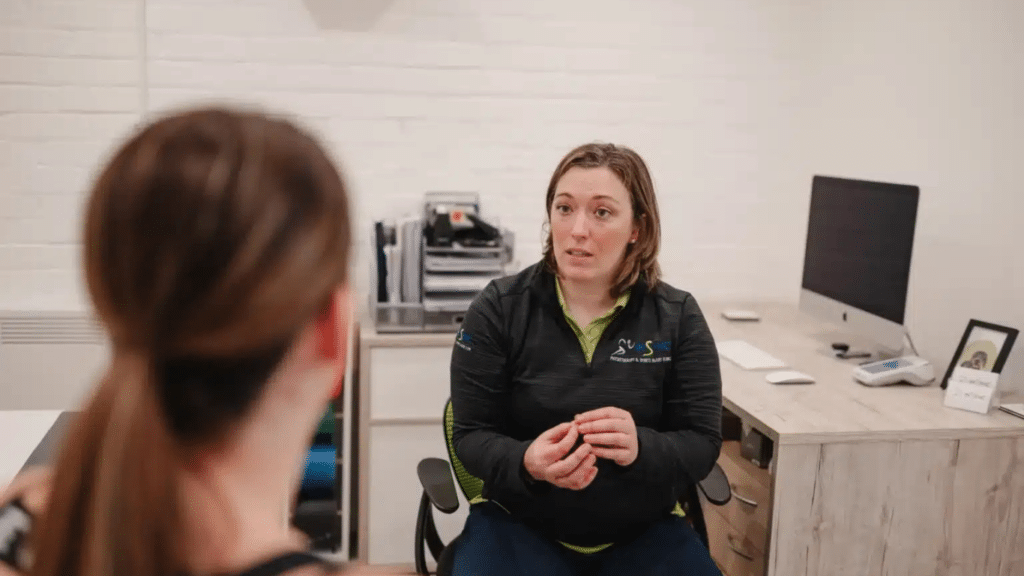
When you come to InSync Therapy for a hip assessment, we start by understanding your symptoms in full. When did the pain start? What makes it worse? What have you tried? Has it changed over time, or does it follow a particular pattern?
We then carry out a physical assessment. This covers your posture, range of motion, hip strength and movement patterns. We test specific muscles and structures to identify where the problem is originating not just where the pain is felt. Pain on the outer hip, for example, may originate from glute weakness or bursitis. Pain in the groin may indicate early osteoarthritis or a hip flexor problem. The location of pain is a starting point, not a diagnosis.
From there, we build a clear picture of what is contributing to your pain and what needs to change.
Your treatment plan may include:
We explain everything clearly, so you understand what is happening and why the plan will work.
When Injection Therapy Is Worth Considering
For some patients, pain levels are high enough to make starting rehabilitation exercises difficult. In these cases, injection therapy can play a useful role not as a cure, but as a tool to reduce pain enough to allow meaningful recovery work to begin.
At InSync Therapy, all injections are delivered by a fully qualified Extended Scope Physiotherapist with advanced training in musculoskeletal care. We offer a range of clinically proven options, and the right choice depends on your diagnosis, pain levels and treatment goals.
For hip osteoarthritis, we commonly use Ostenil Plus or Monovisc both hyaluronic acid injections that lubricate and cushion the joint. Where faster pain relief is needed alongside longer-term support, Cingal combines hyaluronic acid with a corticosteroid for immediate and sustained effect. Orthovisc is also available and is well suited to a series-based approach in larger joints.
Every injection is discussed and agreed as part of your assessment. It is always one option within a broader treatment plan, not a standalone fix and we will always explain the evidence behind any recommendation we make.
To find out more about the full range of options available, visit our injection services page or speak directly to a member of our team.
You Don’t Have to Just Put Up With Hip Pain
Hip pain that will not resolve is telling you something. It is not a sign of weakness, and it is not simply the price of getting older. In most cases, there is a clear cause and a clear path to improvement.
The key is getting the right assessment early, before the problem becomes more entrenched and harder to shift. Waiting does not make hip pain easier to treat. In most cases, it makes it harder.
Whether you are dealing with a persistent ache after running or sport, returning to cricket or football and finding your hip is not cooperating, or noticing a stiffness that has gradually taken over your mornings physiotherapy assessment gives you answers and a plan.
If you are managing hip pain in Hexham, Northumberland or the wider Tyne Valley and you are ready to move forward, contact InSync Therapy to book an appointment. We are here to help you get back to what matters.
Ready to Start Your Recovery?
Whether you’re recovering from surgery, dealing with a sports injury, or just want to feel like yourself again, our expert physiotherapists are here to support you.
Based in Hexham, serving the wider Tyne Valley including Greenhead, Bellingham, Allendale, Matfen and surrounding areas.
Sara Mather.
Founder of InSync
Hexham