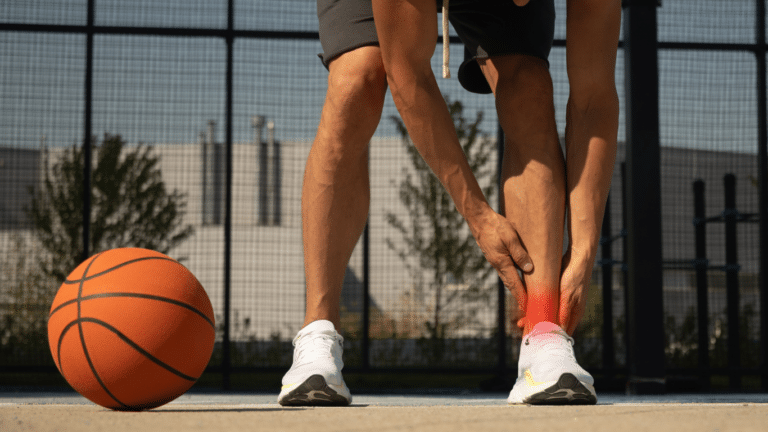
If you have been told you have Achilles tendinopathy, Hexham and the wider Tyne Valley see this injury regularly in runners, footballers, cricketers, and women going through perimenopause. You may already know the frustration. It hurts to walk. It hurts first thing in the morning. And just when you think it is getting better, it flares up again.
You are not imagining it. Achilles tendinopathy genuinely does take longer to heal than most soft tissue injuries. Understanding why and knowing what to actually do about it makes a real difference to your recovery.
At InSync Therapy in Hexham, we work with runners, footballers, cricketers, and women going through perimenopause, all of whom commonly experience Achilles tendinopathy. This post covers what is happening in the tendon, why standard rest does not work, and what the evidence says about recovery.
What Is Achilles Tendinopathy?
The Achilles tendon connects your calf muscles to your heel bone. It carries an enormous amount of load every time you walk, run, or climb stairs.
Achilles tendinopathy is a degenerative condition of the tendon, not simply inflammation. This is why the older term Achilles tendinitis is now considered inaccurate. At a cellular level, the tendon structure becomes disorganised. The collagen fibres which give the tendon its strength break down and fail to regenerate properly.
The result is a tendon that is thickened, weaker, and painful under load. It may feel stiff first thing in the morning and ease as you warm up, only to flare later in the day or after exercise. This pattern is characteristic of the condition.
Why Does Achilles Tendinopathy Take So Long to Heal?
Most people expect an injury to resolve in a few weeks. With Achilles tendinopathy, recovery is often measured in months. There are specific biological reasons for this.
Tendons have a poor blood supply. Unlike muscle tissue, tendons receive very little blood flow. Blood carries the nutrients and cells needed for tissue repair. Less blood flow means slower healing.
The tendon is under constant load. Even when you reduce activity, the Achilles still bears body weight with every step. You cannot truly offload it the way you might rest a shoulder or wrist injury.
Degenerative changes are stubborn. Once the internal structure of the tendon breaks down, rebuilding well-organised, healthy collagen takes time often months, not weeks.
Complete rest makes it worse. This is one of the most important things to understand. If you stop loading the tendon entirely, it does not recover. Tendons need load to stimulate collagen production and rebuild strength. The goal is not rest. The goal is the right kind of load, applied at the right level.
The Graded Loading Protocol: What the Evidence Says
The most evidence-based approach to Achilles tendinopathy is a structured, progressive loading programme. This is sometimes called a graded loading protocol.
The principle is straightforward. You apply load to the tendon in a controlled, systematic way, increasing that load gradually over time. This stimulates the tendon to adapt, reorganise its structure, and rebuild its capacity to handle demand.
The most widely used approach involves slow, controlled calf raises specifically heel drops using an eccentric loading technique. The key is that the exercises must be done correctly, consistently, and at the right stage of recovery.
At InSync Therapy in Hexham, we guide patients through this protocol and adjust it based on how the tendon is responding. There is no single fixed timeline. Some people progress steadily over eight to twelve weeks. Others need the pace adjusted based on symptoms and loading response.
What matters is that loading continues throughout recovery. A tendon that is not loaded does not heal well.
Why Rest Alone Does Not Work
This is worth stating clearly because it contradicts what many people expect from injury management.
When you are in pain, stopping activity feels like the sensible response. You do need to reduce activities that aggravate symptoms but that is different from complete rest.
A tendon that is completely offloaded becomes stiffer, weaker, and less tolerant of load over time. When you return to activity after a period of total rest, the tendon is less capable of handling demand than before. This frequently leads to a second flare-up that feels worse than the first.
The clinical evidence on Achilles tendinopathy is consistent: load the tendon, progressively and carefully. Knowing how much load, how often, and when to increase that is where physiotherapy assessment is essential.
Training Load, Footwear, and Movement Technique
Achilles tendinopathy is rarely caused by a single thing. Several factors usually combine.
Sudden increases in training load are one of the most common triggers. Runners across Northumberland who quickly increase their weekly mileage, or footballers and cricketers returning to full training after a rest period, place a sudden high demand on tendons that are not prepared. Tendons adapt slowly. If load increases faster than the tendon can adapt, the structure begins to break down.
Footwear also plays a role. Shoes with inadequate heel cushioning or a very flat heel-to-toe drop can increase the mechanical demand placed on the Achilles during each stride.
Movement technique can contribute as well. If ankle control, hip stability, or trunk strength is poor, the Achilles compensates. This is why a physiotherapy assessment looks beyond the area that hurts.
At InSync Therapy, we assess the whole movement chain not just the tendon in isolation.
Oestrogen, Perimenopause, and Achilles Tendon Health
This section is particularly relevant to women in their 40s and beyond.
Oestrogen plays an important role in collagen production. As oestrogen levels decline during perimenopause and menopause, the body produces less collagen and the quality of existing collagen changes. This affects tendons, ligaments, and joints throughout the body.
The Achilles tendon is especially vulnerable. Women going through hormonal changes often find that tendons feel stiffer, more painful, or slower to recover than they did previously. An Achilles injury developing during this period is not bad luck or a sign of aging badly. There is a clear biological explanation.
If you are experiencing Achilles pain alongside other symptoms of perimenopause, it is worth discussing this with your GP as well as your physiotherapist. Managing hormonal health and tendon loading together gives you the best chance of recovery.
We will be covering perimenopause and musculoskeletal health in more depth in our upcoming June blog post.
When Shockwave Therapy Can Help
For some people, graded loading alone is not enough. If you have been dealing with Achilles tendinopathy for three months or more, shockwave therapy may be the appropriate next step.
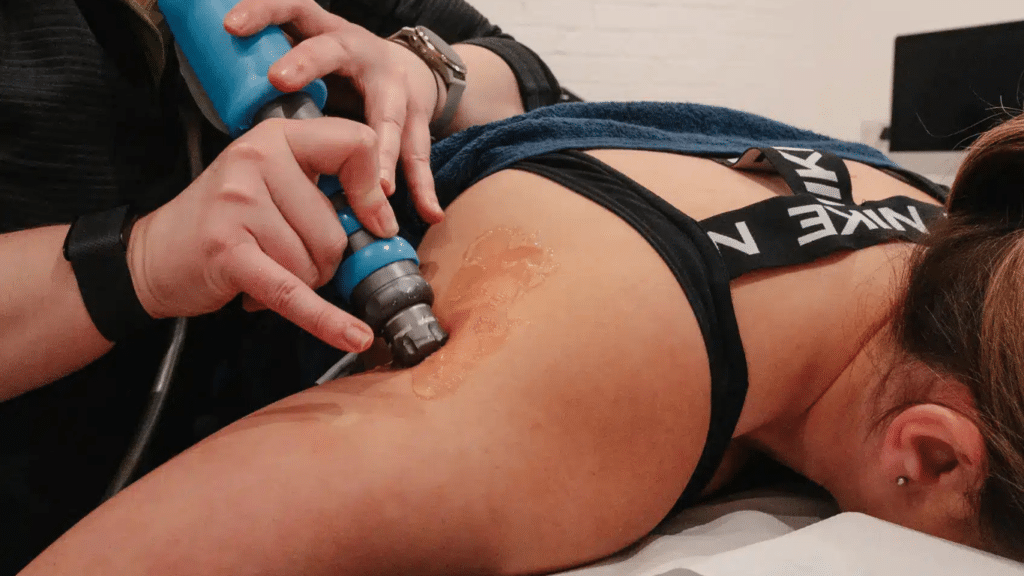
Shockwave therapy delivers focused acoustic energy pulses directly into the tendon. This stimulates the tendon’s own repair processes, encourages new blood vessel formation, and disrupts chronic pain signalling. It is a non-invasive treatment well-supported by clinical evidence for persistent tendinopathy.
At InSync Therapy in Hexham, we offer shockwave therapy as part of a structured rehabilitation programme. It is not a standalone fix. It works best when combined with appropriate progressive loading, technique correction, and movement management.
We typically consider shockwave therapy when:
You can find out more on our shockwave therapy service page.
Returning to Running, Sport, and Full Activity
Recovery does not end when pain reduces. A tendon that is no longer painful is not necessarily ready for full sporting demand.
Many people return too quickly once symptoms ease. The tendon is still rebuilding internally. Return to sport should follow a structured programme that gradually reintroduces running, jumping, change of direction, and sport-specific movement.
For runners in the Tyne Valley, we develop return-to-run plans that match your specific goals whether that is a local parkrun, a half marathon, or simply getting back to pain-free walking.
For footballers and cricketers, the same principle applies. We assess the demands of your sport and ensure the tendon can meet them before you step back into full training.
What to Expect from Assessment at InSync Therapy
If you come to us with Achilles tendinopathy in Hexham or across the Tyne Valley, here is what your assessment will cover:
Recovery from Achilles tendinopathy is rarely a straight line. There will be good weeks and harder weeks. Our job is to keep you progressing through both.
Achilles Tendinopathy Hexham, Get a Clear Plan for Your Recovery
If you are managing Achilles tendinopathy, Hexham-based InSync Therapy can help with a structured recovery plan. We work with runners, team sport players, and anyone dealing with persistent tendon pain at any stage of life.
Book an assessment today and get a programme built around your goals, your sport, and your body.
Ready to Start Your Recovery?
Whether you’re recovering from surgery, dealing with a sports injury, or just want to feel like yourself again, our expert physiotherapists are here to support you.
Based in Hexham, serving the wider Tyne Valley including Greenhead, Bellingham, Allendale, Matfen and surrounding areas.
Sara Mather.
Founder of InSync
Hexham