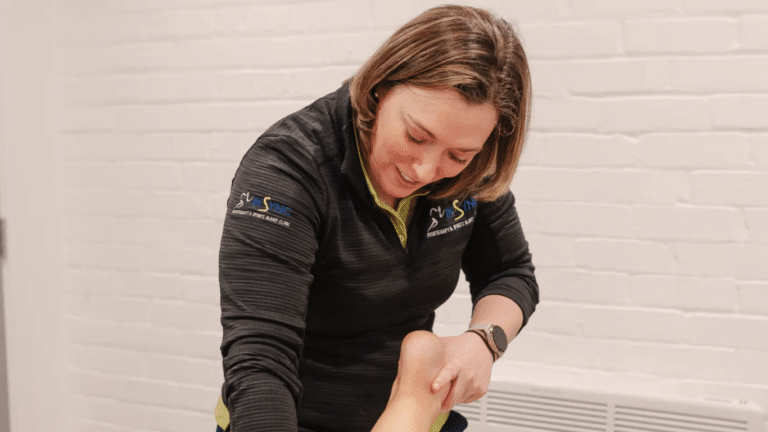
In our Hexham clinic, we regularly see women in their mid-40s who haven’t connected joint stiffness, longer recovery times or persistent tendon pain to hormonal change. Once the link is understood, the path forward becomes much clearer.
You are in your early 40s. You have started waking up with stiff hips. Your knees ache after a walk. Your shoulder has been sore for months without a clear cause. Nothing has changed in what you do. So what is going on?
For many women, perimenopause is the answer and it is one that rarely comes up in a standard GP appointment.
Perimenopause is the hormonal transition that precedes the menopause. It can begin in your late 30s and continue into your early 50s. Most people associate it with hot flushes and mood changes. Fewer people know that falling oestrogen has a direct and measurable effect on your joints, tendons and cartilage. The perimenopause can last anywhere from a few years to over a decade. During this time, oestrogen levels fluctuate and gradually decline. The musculoskeletal system feels this.
At InSync Therapy in Hexham, we see this regularly. Women arrive with perimenopause joint pain in Hexham and across the Tyne Valley that has appeared without any obvious injury or cause. It is more common than most people realise, and physiotherapy can help.
There is a great deal of information available about perimenopause at the moment. Much of it is accurate and useful. It covers hormones, mood, sleep, weight and cardiovascular health.
What tends to receive far less attention is what the hormonal transition does to the musculoskeletal system joints, tendons, ligaments and connective tissue. This is the part of the picture that most perimenopause content leaves out, and it directly explains many of the physical changes active women in their 40s notice but cannot account for.
This article covers that specific dimension: the clinical relationship between hormonal change and joint and tendon health, and what physiotherapy offers that general perimenopause advice cannot.
What Does Oestrogen Have to Do With Your Joints?
Yes — oestrogen directly affects joint health. It does more than regulate your menstrual cycle. It plays an active role in maintaining the health of your musculoskeletal system.
It helps sustain cartilage the protective tissue that cushions your joints. It supports tendon strength and flexibility. It also carries an anti-inflammatory effect, which helps shield tissues from the wear of everyday movement.
When oestrogen levels begin to decline during perimenopause, these protective effects reduce. Cartilage can become thinner. Tendons may lose some of their elasticity. Inflammatory responses become more likely. Oestrogen receptors are found in tendon tissue, meaning tendons are directly responsive to hormonal change. The result is joint pain that appears without any obvious trigger.
This process is gradual. But for many women, it begins in their late 30s well before the menopause is formally confirmed.
Why Do Injuries Take Longer to Heal in Your 40s?
Injuries take longer to heal in your 40s because lower oestrogen slows collagen production the structural protein your body uses to repair tendons, ligaments and cartilage.
Lower oestrogen means slower collagen synthesis. Tissues repair more slowly. Inflammation takes longer to resolve. Connective tissue becomes less resilient overall, meaning recovery from strains and overuse injuries may now take several months instead of days.
Women in perimenopause are at higher risk of tendon injuries. The Achilles tendon, the rotator cuff in the shoulder and the tendons around the hip and knee are all more vulnerable during this hormonal transition.
Understanding this changes how you approach recovery. Rest alone is rarely the answer. Targeted loading the right exercises applied progressively stimulates collagen production and helps rebuild tissue strength over time.
Which Joints Are Most Commonly Affected?
The four joints most commonly affected by perimenopausal hormonal change are the hips, knees, shoulders and hands.
Hips
Hip pain is one of the most common presentations we see. The hip joint depends on cartilage integrity, muscle strength and tendon health. When oestrogen drops, all three can be affected. Women often describe a deep ache, morning stiffness or discomfort when lying on their side at night.
Knees
The knee is particularly vulnerable to cartilage changes. Many women in their 40s notice increased achiness or swelling after activity. Early osteoarthritis becomes more common after the menopause, and the process frequently begins during the perimenopausal years. For more on osteoarthritis, Versus Arthritis provides a useful independent guide.
Shoulders
Frozen shoulder adhesive capsulitis is significantly more common in women aged 45 to 55. Hormonal changes are considered a contributing factor. If your shoulder has become gradually stiffer and more painful without a clear injury, it should be properly assessed.
Hands and Wrists
Aching, stiffness and swelling in the fingers and wrists is another common pattern. This is sometimes mistaken for early rheumatoid arthritis, which should always be ruled out. Perimenopausal joint changes in the hands are common and generally respond well to targeted physiotherapy.
What a GP Appointment May Not Cover
Musculoskeletal symptoms are an underreported aspect of perimenopause and a standard GP appointment rarely has room for both hormonal and joint health in depth.
Hormone replacement therapy HRT can help some women manage joint symptoms by restoring oestrogen levels. But HRT is not suitable for everyone, and it does not address the physical deconditioning, muscle weakness or movement dysfunction that develops alongside joint pain.
Joint pain, tendon issues and reduced mobility are often attributed to general ageing rather than hormonal change. If you have been told your symptoms are simply part of getting older, it may be worth seeking a physiotherapy assessment.
Physiotherapy addresses the mechanical side of the problem how you move, where your strength has declined, and where load is being distributed unevenly through a joint. HRT and physiotherapy are not mutually exclusive. For many women, they work best in combination.
This is where physiotherapy specifically sports injury physiotherapy offers something that general menopause advice cannot. The clinical focus is not on hormones themselves, but on what hormonal change does to tissue: how tendons lose elasticity, where collagen synthesis has slowed, which joints are carrying uneven load, and how movement patterns have adapted around pain. These are mechanical questions, and they require a mechanical assessment.
A physiotherapist with a sports injury specialism is placed to assess and address exactly this. Not to replace the hormonal conversation, but to address the physical dimension that runs alongside it and that often persists even when hormonal management is in place.
Perimenopause, Bone Density and Long-Term Joint Health
Oestrogen also protects bone density. When levels fall, bone loss accelerates and this process begins during perimenopause, not just after the menopause.
Low bone density osteopenia or osteoporosis increases the risk of fractures, particularly of the hip, spine and wrist. Early intervention matters, and women in their 40s are not too young to start thinking about this.
Resistance exercise is one of the most effective strategies for maintaining bone density. Weight-bearing movement creates mechanical stress on bone tissue, which stimulates bone formation. This is one of several reasons why strength training should be a priority for women in their 40s not just walking or swimming, but progressive loading.
A physiotherapy assessment can identify where your strength gaps are and help you build a programme that supports both your joints and your bones. Women across the Tyne Valley and Northumberland can access this support at InSync Therapy in Hexham.
How Physiotherapy Helps With Perimenopause Joint Pain
Physiotherapy addresses perimenopause joint pain by reducing load through affected joints, rebuilding strength and stimulating the collagen synthesis that hormonal change has slowed.
Assessment. We start with a thorough assessment covering your pain pattern, movement quality, activity levels and history. We assess joint range of motion and muscle strength to identify what is driving your symptoms.
Targeted exercise. Strength work is the foundation of managing perimenopause joint pain. Stronger muscles reduce the load on joints and stimulate collagen production in tendons. We design progressive resistance exercise tailored to your specific weaknesses and your specific joints.
Manual therapy. Where joint stiffness or soft tissue restrictions contribute to pain, hands-on treatment can help restore range of motion and reduce discomfort.
Education and self-management. We explain what is happening in your body and why your joints are responding the way they are. We give you the tools to manage flare-ups, pace your activity and keep progressing.
The Role of Pilates in Perimenopausal Joint Pain
Clinical Pilates is one of the most effective tools for women managing joint pain during perimenopause and it is frequently underused.
Pilates builds strength through controlled movement. It improves core stability, postural alignment and the way load is managed through the spine, hips and knees. It is low-impact, which makes it well tolerated even during painful flare-ups.
At InSync Therapy, we use Pilates as part of a wider rehabilitation programme. Learn more about our approach at insynctherapy.co.uk/services. Pilates works well alongside targeted strengthening to address the specific areas most affected by hormonal change: hips, lower back, shoulders and pelvic floor.
Women who engage with regular Pilates alongside physiotherapy often report improved pain levels, better sleep and greater confidence in their bodies.
Practical Steps You Can Take Now
If your joints feel different stiffer, slower to recover, more reactive do not wait for a formal diagnosis. Small, consistent actions make a meaningful difference from day one.
Frequently Asked Questions
Book an Assessment at InSync Therapy, Hexham
Perimenopause joint pain in Hexham is one of the most common reasons women come through our door and it is one of the most treatable, when it is properly understood.
At InSync Therapy, we work with women across Hexham, the Tyne Valley and Northumberland who are managing exactly this. We offer physiotherapy assessment, targeted rehabilitation, exercise therapy and Pilates all in a calm, clinical environment.
If your body has been telling you something is different, we can help you make sense of it and build a practical plan for recovery.
To book an assessment, visit insynctherapy.co.uk or contact our Hexham clinic directly.
Ready to Start Your Recovery?
Whether you’re recovering from surgery, dealing with a sports injury, or just want to feel like yourself again, our expert physiotherapists are here to support you.
Based in Hexham, serving the wider Tyne Valley including Greenhead, Bellingham, Allendale, Matfen and surrounding areas.
Sara Mather.
Founder of InSync
Hexham